
If you’re looking for content writers or copywriters, you probably want to:
- Convert website or blog visitors into leads or customers
- Create content that educates, engages, and guides readers toward a purchase
- Sustain your inbound marketing strategy with a steady stream of relevant content
- Improve your content’s rankings on Google search results pages
- Drive more organic traffic to your product or service pages
- Attract more qualified users through search engine optimized content
Content platforms and agencies help scale production, especially during the validation and scaling phases as a content strategy evolves:
- Validation Stage: In this initial phase, you’re testing your SEO and content marketing strategy to see whether it actually delivers results. The focus is on verifying whether content can appear in Google searches and attract visitors who convert into leads or customers. This is the time to experiment with keywords (both long-tail ones, which deliver faster results, and more competitive ones, which take longer) and confirm that the approach works before scaling investment.
- Scaling Stage: Once you’ve confirmed that the strategy has potential, it’s time to amplify results. At this stage, the goal is to systematically increase the number of conversions. This is done by investing more in your keyword mix, strengthening link building (through partnerships and guest posts), and maintaining consistent high-quality content production. The focus is on growing your numbers steadily, always balancing quick wins with long-term goals.
But as the strategy matures and the blog starts ranking well, a new challenge emerges: maintaining those positions and continuing to convert visitors into leads and customers.
- Maintenance and Defense Stage: When the strategy has secured many top positions on Google (usually after a year or more), the challenge shifts to holding those gains. Here, the focus moves to protecting, updating, and optimizing content that’s already ranking well. This requires constantly monitoring positions, adjusting content as user behavior or Google’s algorithm changes, and continuing to build quality links. All of this works to prevent rankings from slipping and preserve the investment already made.
At this point, many companies realize that mass-produced content is no longer cutting it. The problem is the strategic quality of the writing. And that’s where the risk lies:
- Google rankings start to fluctuate
- Articles attract traffic but don’t generate leads
- Content loses relevance
- Competitors with stronger content start taking over top positions
Over 10 years as a content writer, I worked through every stage, from validation to results maintenance, and been responsible for:
- Writing more than 582 blog articles for blogs in the education and digital marketing sectors
- Reviewing more than 675 blog articles across various industries to ensure quality and alignment with clients’ marketing goals
- Developing more than 155 content briefs for blog articles across education, digital marketing, e-commerce, and SaaS companies
Hundreds of articles written, reviewed, and planned. And across every project I closely followed, one pattern kept repeating itself:
The struggle to find writers who master the engineering behind an article that actually converts
Because writing well isn’t enough. You need to:
- Listen to the voice of the customer
- Use data to develop strategic briefs
- Guide readers precisely through their awareness levels
- Apply persuasion techniques without feeling forced
- And ultimately deliver content that generates results
Few writers combine analytical thinking with a consistent focus on conversion: the kind that generates leads and sales from organic content.
It’s precisely this rare combination that separates content that converts from content that merely informs
That’s why I work as a conversion copywriter and content strategist. I partner with companies that want to generate real results through:
- Blogs that convert organic visitors into customers ready to buy.
- Emails that turn subscribers into customers, increase average order value, support the sales team, and build credibility with both prospects and existing clients.
- Websites that do the work of a salesperson, connecting visitors to the right offer and moving them toward a purchase.
I continuously learn from the best in the field: Copyhackers by Joanna Wiebe, CXL Institute, and Grow & Convert, to apply tested and validated strategies that help generate leads, sales, and ROI from content.
The biggest lesson from these 10 years: I realized there are 2 nearly invisible elements that make all the difference in conversion
Transformation and Realization. Great articles do more than inform: they change how the reader sees something.
- They make the reader envision themselves differently, in a new situation.
- And/or they show the reader something about their situation they had not noticed before, changing how they think, decide, or act.
This kind of content stands out because it creates emotional connection and offers clarity. It helps readers better understand their own problem and recognize the role and value of the solution in that process.
In the words of Talia Wolf, founder and CEO of CRO agency Getuplift:
Persuasive content isn’t about forcing a purchase decision. It’s about:
✓ Clearly showing how your solution solves a specific problem for this person
✓ Proving that your solution is different from everything they’ve tried before
✓ Giving them confidence that they can use this solution without risking their job, without implementation headaches, and without that fear or worry they’d normally have.
If your content (whether article, landing page, or email) does not address these points, people will leave.
Your mission is to prevent customers from having to work hard to understand what sets you apart from the competition.
Instead of generic messaging, clearly show that your solution was built to meet their specific needs.
This should show up in the way you communicate, the images you choose, the social proof you present, and even how you organize your navigation.
That’s why my approach combines strategy, narrative, and conversion copywriting.
I bring the principles of some of the world’s leading references in content, copywriting, and performance marketing into every article, email, and web page:
- Copyhackers by Joanna Wiebe: to structure copy with a focus on conversion and guide readers intentionally toward action.
- CXL Institute: to apply frameworks grounded in data, testing, and user behavior.
- Grow & Convert: to turn bottom-of-funnel blog content into a source of organic lead generation and sales.
All of this connects and is reinforced by the concepts Matthew Dicks teaches in his book Stories Sell. It is about how to tell stories that make audiences connect with and remember brands, products, and services:
- Transformation: “I used to be one way. After reading this article, I’m starting to picture myself differently. And maybe this product or service can help me become that person.”
- Realization: “I used to think one way, but reading this article showed me something new. Now I see other possibilities, and maybe this product or service can help me get there.”
I apply all of this so that every article, email or web page becomes a strategic piece, designed to move the reader from point A to conversion.
So what does this look like in practice?
To show how I apply all of this in bottom-of-funnel article production, I’ll use 2 examples close to the type of project I typically develop.
Transformation in practice: A bottom-of-funnel article based on a student testimonial from an online exam prep platform
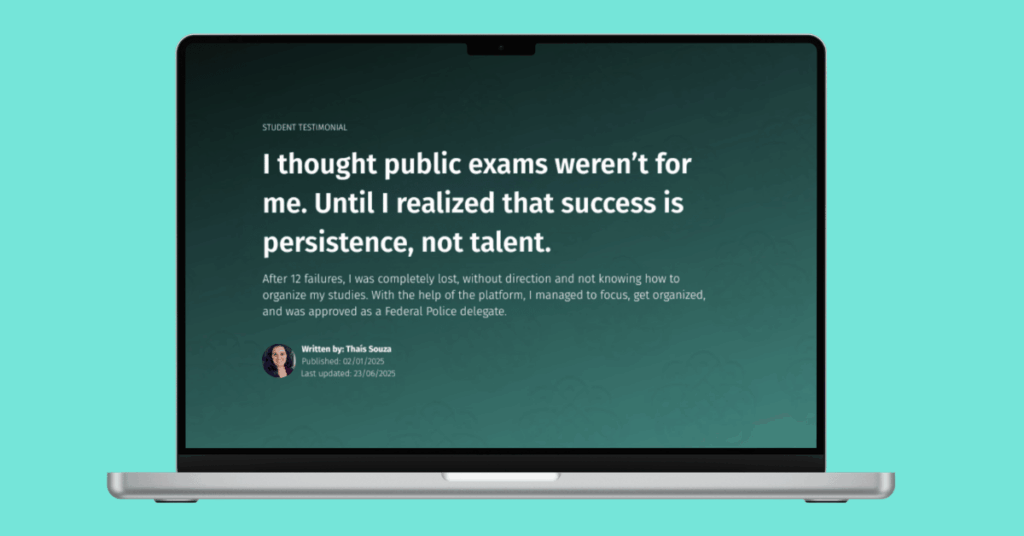
Content like this can be built around the testimonial of a student who was considering giving up on pursuing a public service exam.
She shares her struggles, explains how she found the platform, and shows how she got back on track and passed.
The QUEST copywriting framework works well for this type of content:
- Q – Qualify: Qualify the prospect. Grab the attention of the person you want to reach so you attract the right audience.
- U – Understand: Show that you understand exactly where this person is, what they’re feeling, and why it bothers them.
- E – Educate: Educate the reader by presenting a better way to solve the problem: the real solution that made a difference for someone who has been through it. In this example, that solution is the online exam prep platform.
- S – Stimulate: Spark desire for that solution by showing the results, the proof, and the small wins it makes possible.
- T – Transition: Invite the reader to take action clearly. Turn prospects into customers with a compelling call to action.
The goal is to show a possible path, backed by evidence and empathy. The reader identifies with the story, starts to picture themselves in a new situation, and decides to give it a try.
When this reader lands on this content, they may be in a tough place, feeling unmotivated and thinking exams just aren’t for them. Right away, they see someone in the same situation.
As they read, they encounter a student who faced the same challenges and describes, in detail, everything she did and how the platform was essential in helping her get back on track and pass.
By the end, the reader may start imagining themselves differently, realize the platform might help them achieve their goal, and decide to sign up and try it out.
Realization in practice: A bottom-of-funnel article based on a student testimonial from an online exam prep platform
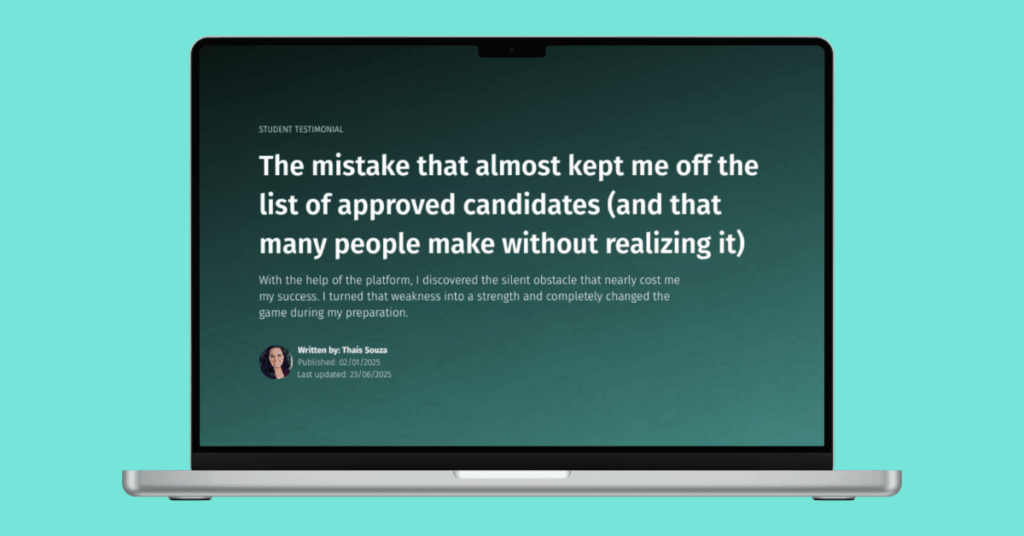
Another common scenario: the reader doesn’t realize they’re neglecting a crucial part of their preparation (like grammar).
When they read an article featuring someone who made that same mistake and managed to correct it, they recognize themselves in the story, and that changes their perspective.
This type of article can be built around a customer testimonial using the PAS-on-Steroids copywriting framework, developed, tested, and validated by Joanna Wiebe of Copyhackers. Here’s how each stage works:
- Problem: Start by identifying a real problem the person is facing, even if they have not put a name to it yet.
- Agitation & Transition to Solution: The problem is intensified by exploring the pain and frustration it causes, why other solutions have failed the reader, and building the groundwork for introducing the solution you’re about to offer.
- Solution: Present the solution in the words your reader needs to hear, which also works to calm the agitation built up in the previous stage.
- Why: Explain why this solution is different, why the company has the answer, why the product was built to solve this specific problem, and why it’s better than any alternative for the reader.
- Try: Explore and demonstrate the solution’s features (always tied to benefits) and make them clear and fully understood through proof: testimonials, case studies, statistics, and more.
- Buy: After the content has presented the product’s benefits, built trust, and generated interest, the close comes in to convert that interest into action. This is where you make the next step crystal clear (buy, sign up, schedule, get in touch) and remove any doubts or objections that might be holding the visitor back. In short: reinforce the value of the offer, show that the risk is minimal (or nonexistent), and invite them with confidence and clarity.
Notice how both examples guide the reader from their current awareness level all the way to the point of conversion?
Content that converts doesn’t manipulate or push products: it reveals how they work, proves why they’re different, and offers confidence in the choice
That’s the kind of strategic thinking I bring to my clients’ projects.
And testimonial-based content is just one of the formats I work with. My production also includes:
Purchase-intent articles, which help readers make decisions with more confidence.
- How much does it cost to subscribe to Gran Cursos Online?
- Which Gran Cursos Online plan should I choose: 1-year unlimited or lifetime unlimited?
Comparison articles, which present pros, cons, and differentiators honestly to make the choice easier.
- In-person vs. online courses: which prepares you better for public service exams?
- Gran Cursos Online vs. Estratégia: which is better for beginners?
Alternative articles, aimed at people who are unhappy with their current solution and looking for another option.
- Estratégia didn’t work for me. Now what? Other options for exam candidates
- Studying on YouTube and not seeing results? Discover the best alternatives for exam candidates
Category or product-type articles, serving people who are looking for a solution but haven’t yet settled on a brand.
- Online courses for entry-level public service exams: see your options
- Online prep courses for banking exams: what to look for
Use-case articles, presenting real-world scenarios where the product or service can be helpful.
- Courses to prepare for ANVISA public service exams
- The right prep course for municipal teacher exams
Jobs to Be Done (JTBD) articles, addressing real audience questions and connecting the problem to the solution.
- How to build a study schedule that actually works for exam candidates
- How to study for public service exams even with ADHD or anxiety
In other words: Each article is engineered to sell, not only to rank. They do the work of a sales page, without reading like one.
They’re strategically planned and written to attract, transform, realize, and convert.
And for that to happen, you need to master the engineering behind writing strategic content.
To spark a transformation or realization in the reader (capturing their attention and staying in their memory), the writer you’re looking to hire needs a range of content marketing and conversion copywriting skills, including:
- Finding, analyzing and working with Voice of Customer (VoC) data.
- Researching and identifying keywords and topics with high conversion potential for any type of business (B2B, B2C, services, e-commerce).
- Developing a results-driven content strategy that helps generate leads or sales from blog articles.
- Moving readers from their current awareness level to the point of conversion throughout the article, making them say “yes” to your solution.
- Writing articles that match the market’s sophistication level: articles that stand out in organic search, impress the target audience, and increase the chances of ranking for purchase-intent keywords.
- Being specific in your writing. People remember things they can visualize. Specificity is key to capturing the reader’s attention.
- Mastering the strategic placement of CTVs and CTAs, knowing where, how, and why to insert calls to action in copy to maximize conversions.
These are some of the key skills that separate writers who generate conversions from writers who only deliver traffic. Remember: ideally, almost every article on a company’s blog should contribute to generating leads or sales for the business.
Need a writer who masters persuasive writing and the engineering behind content that converts? Get in touch to talk about your project and explore how your blog can drive results for your company.
